# Some Stories, or a Profile (within "FIXER") © Chiaki Haibara
FIXER
FIXER
STATEMENT
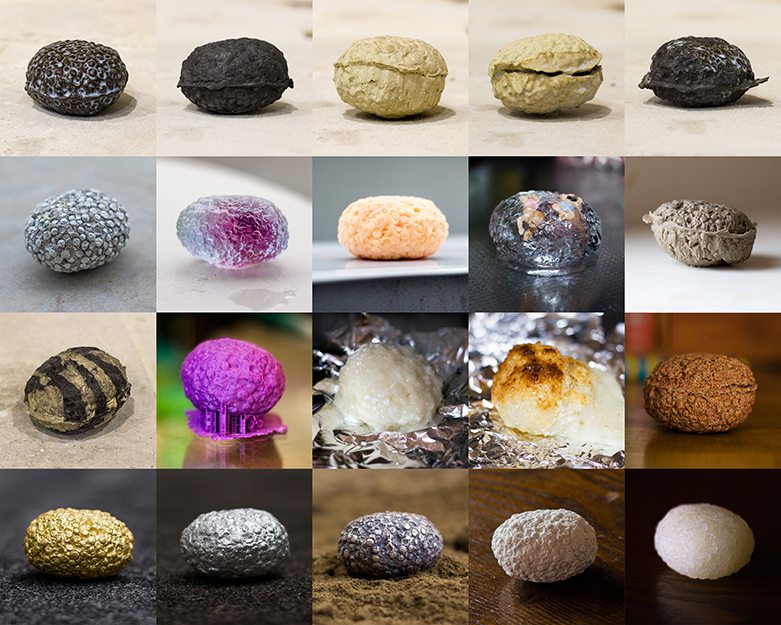
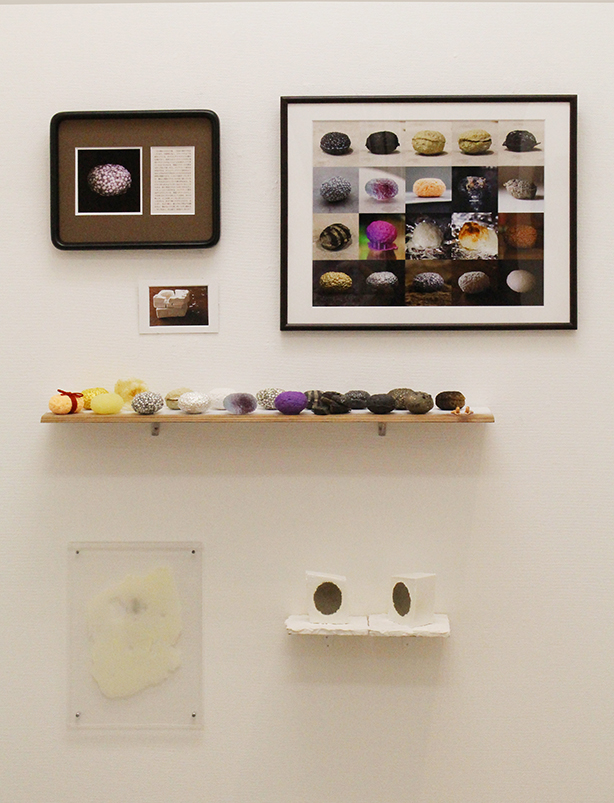
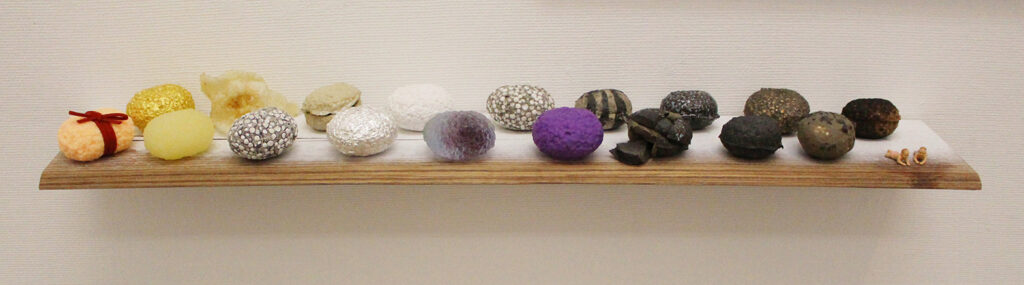
本作は、ギャラリーなつかにて2014年7月21日から8月2日まで開催されたグループ展「View’s view -Next-」において発表された壁面作品で、「わからないものをわからないまま受け止める」という態度を起点としている。ファウンドオブジェクトを出発点に、その形を模倣や転写によって反復的に扱いながら、「それが何であるのか」という問いを持続させるプロセスとして構成されている。パラフィンなどの複製や型取りのための素材も作品の一部として組み込まれ、提示されるのは完成された物体ではなく、物体が物体として認識されていく過程そのものである。
タイトル「FIXER」は、未定義のものに意味を与える主体としてのアーティストを指すものではない。むしろ、不確定なものが「定義可能なもの」として立ち上がってしまう、言語や意味の作用の中で生じる位置を示している。ここでアーティストは、意味を決定する主体ではなく、「それが何であるのか」を繰り返し問われる状況のなかで生成される存在として位置づけられる。主体はあらかじめ存在するのではなく、意味を求められ続ける過程のなかで後から立ち現れる。
ー以下に作品内で用いられたテキストを掲載する。
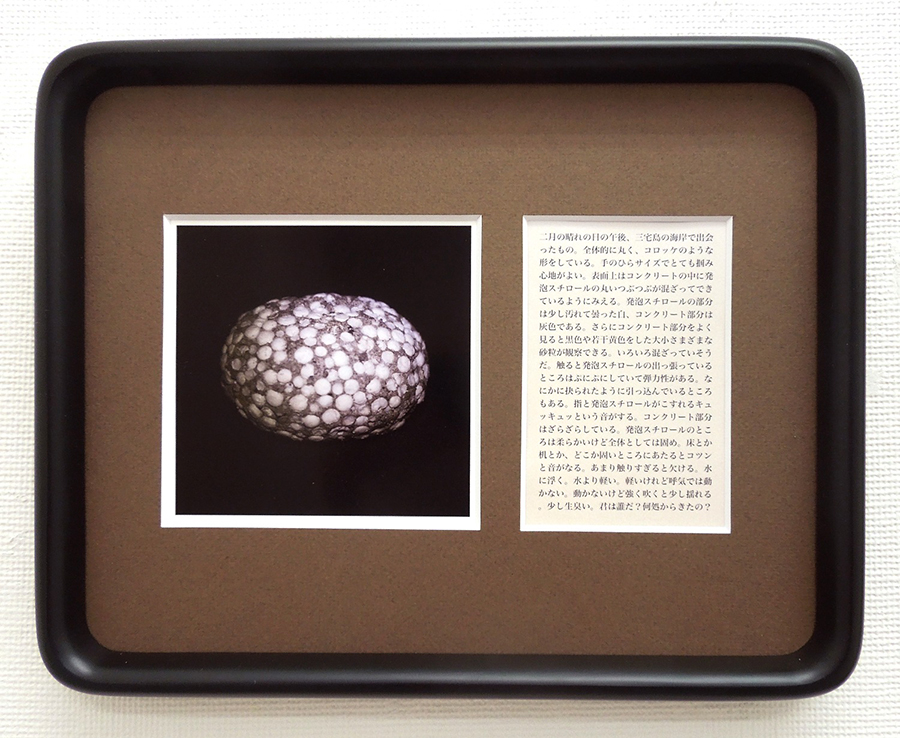
二月の晴れの日の午後、三宅島の海岸で出会ったもの。全体的に丸いけれど、例えればコロッケのような形をしている。手のひらサイズでとてもつかみ心地がよい。表面上はコンクリートと発泡スチロールの丸いつぶつぶでできているように見える。発泡スチロールの部分は少し汚れた白、コンクリート部分はネズミ色である。ネズミ色の中にも少し黄色い部分や、黒い部分がある、小さなつぶつぶが見える。いろいろ混ざっていそうだ。触ると発泡スチロールの出っ張っているところがぷにぷにして弾力性がある。なにかに抉られたように引っ込んでいるところもある。発泡スチロールがこすれるキュッキュッという音がする。コンクリート部分はざらざらしている。発泡スチロールのところは柔らかいけれど全体的に固め。床とか机とか、どこか固いところにあたるとコツンという。あまり触りすぎると欠ける。水に浮く。水より軽い。軽いけれど呼気では動かない。動かないけど強く吹くと少し揺れる。少し生臭い。君は誰だ。
This wall-based work was presented in the group exhibition “View’s view -Next-” at Gallery Natsuka, held from July 21 to August 2, 2014. It begins from an attitude of accepting what cannot be understood without forcing it into understanding. Starting from found objects, the work is structured as a process in which their forms are repeatedly handled through imitation and transfer, sustaining the question of “what it is.”
Materials used for replication and casting, such as paraffin, are also incorporated as part of the work. What is presented is not a completed object, but the process through which an object comes to be recognized as an object.
The title “FIXER” does not refer to the artist as a subject who assigns meaning to what is undefined. Rather, it points to a position that emerges within the operations of language and meaning, where something indeterminate comes to appear as definable. In this context, the artist is not a subject who determines meaning, but one who is formed within a situation in which the question of “what it is” is repeatedly posed. The subject does not pre-exist, but emerges through the ongoing demand for meaning.
The following text appears in the work:
On a clear February afternoon, I encountered something on the coast of Miyakejima.
It was round, though its shape recalled a croquette—something almost edible, almost familiar. Palm-sized, it fit the hand with an unexpected comfort. From a distance, it looked like a composite of concrete and Styrofoam granules. The Styrofoam was a slightly soiled white; the concrete, a mouse-grey scattered with traces of yellow and black, as if many small histories had been embedded within it. When touched, the protruding Styrofoam yielded softly, with a quiet elasticity. Some parts were hollowed out, as if something had once bitten into it. Rubbing it produced a faint, almost embarrassed squeak. The concrete remained dry and rough, resisting the skin. Soft in places, yet firm as a whole, it answered the world with a dull “clunk” when dropped onto hard surfaces. It chipped easily, as if memory itself were fragile. It floated on water, lighter than water, yet unmoved by breath. Even so, a strong exhale made it tremble, briefly, uncertainly. There was a faint smell of the sea—almost animal, almost forgotten. Who are you?