空っぽの巌

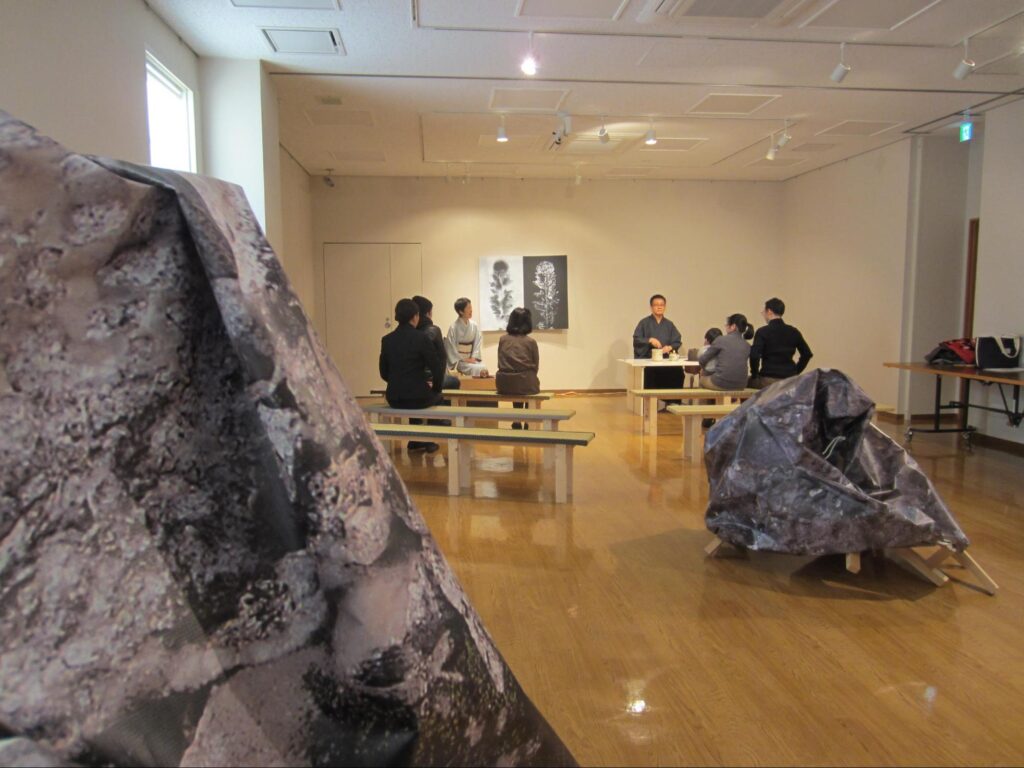
Installation view of "Hollowed Sazare-ishi," from "To the Other Side of the Boundaries," Gallery C, Tokyo Metropolitan Art Museum, 2017. Photo by Tada (Yukai).

空っぽの巌

Hollowed Sazare-ishi
YEAR
2017
MEDIUM
印刷されたターポリン、木材
Printed tarpaulin, scrap wood
SIZE
H140 × W140 × D100 / H100 × W90 × D90 / H220 × W135 × D170 cm
PHOTO
ただ(ゆかい)/ Tada (Yukai)

STATEMENT

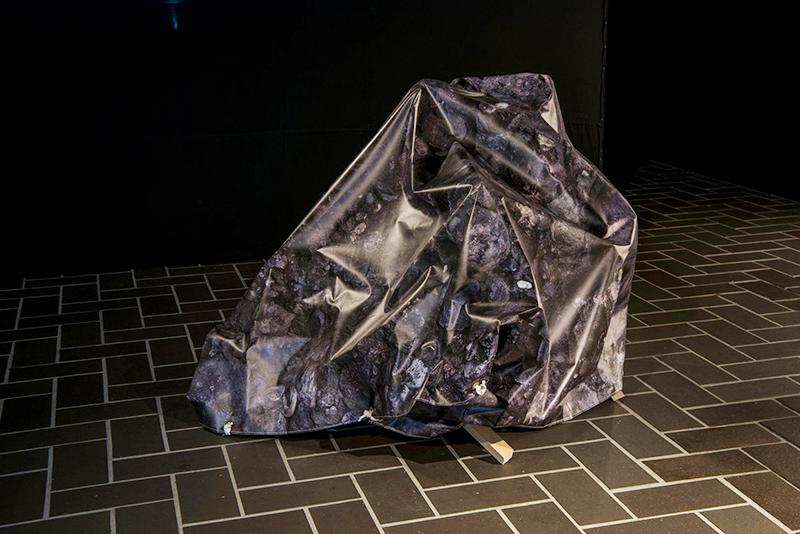
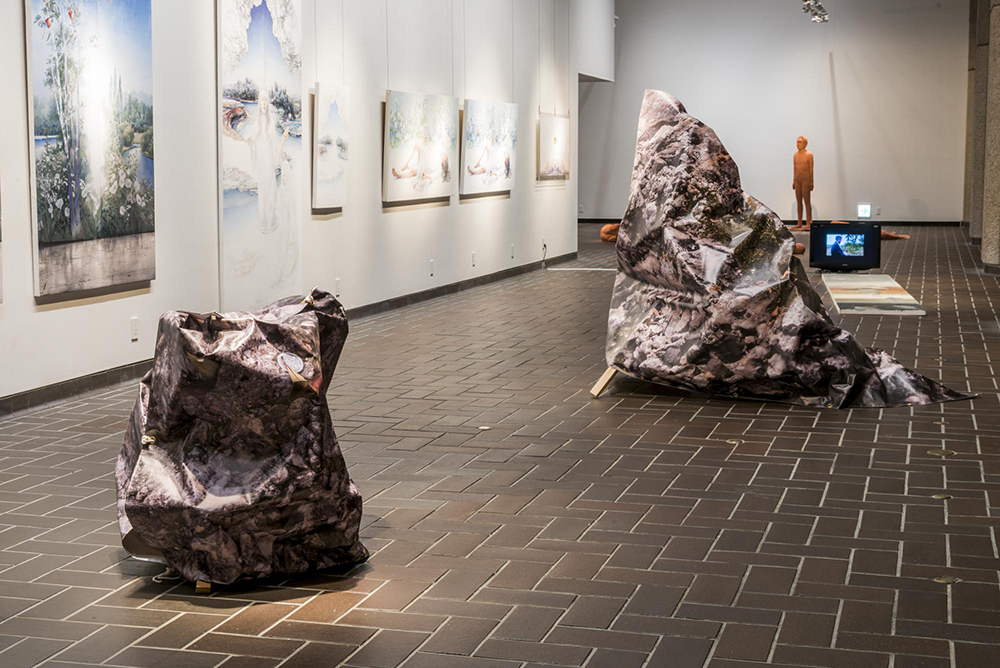
本作は、都内の神社にある「さざれ石」の写真を撮影し、それらをターポリンに印刷したうえで、垂木を組んだフレームを覆うように構成されたソフト・スカルプチュアである。

日本の国歌「君が代」において「さざれ石」は、細石が長い年月をかけて凝結し巌となるという象徴性を持ち、国家の永続性や共同体の結束を表象する記号として機能してきた。しかしその強度は、物質としての岩そのものにあるのではなく、語りと解釈の反復によって支えられているのではないか。

また「君が代」自体も、『古今和歌集』以来の長い受容の歴史のなかで、時代ごとに解釈を変容させながら読み替えられてきた。その姿は、形態を保持しながらも意味が絶えず更新され続けるテクストとしての憲法にも似ている。

国民の絆を謳うこの巌は、果たして確かな強度を持つのだろうか。それとも、それは常に更新され続ける解釈の累積によってのみ成立しているのだろうか。

This work is a soft sculpture constructed by photographing sazare-ishi (a cluster of pebbles traditionally regarded as a sacred stone) found in shrines in Tokyo, printing the images on tarpaulin, and wrapping them around a framework assembled from scrap wood.

In the Japanese national anthem Kimigayo, “sazare-ishi” carries the symbolism of small stones gradually cementing together over a long span of time to become a massive rock, functioning as a signifier of national continuity and communal unity. However, the strength of this image may not lie in the rock as a physical substance itself, but rather in its sustained repetition through acts of narration and interpretation.

Likewise, Kimigayo itself has been continuously reinterpreted and reread throughout history since its inclusion in the Kokin Wakashū, shifting its meaning across different historical contexts. In this sense, it resembles a constitutional text whose form remains intact while its meaning is continually updated.

Does this rock, which sings of the bonds of the nation, truly possess a stable strength? Or does it exist only through accumulated layers of interpretation that are constantly revised?

空っぽの巌

Installation view of "Hollowed Sazare-ishi," from "To the Other Side of the Boundaries," Gallery C, Tokyo Metropolitan Art Museum, 2017. Photo by Tada (Yukai).

空っぽの巌

Hollowed Sazare-ishi
YEAR
2017
MEDIUM
印刷されたターポリン、木材
Printed tarpaulin, scrap wood
SIZE
H140 × W140 × D100 / H100 × W90 × D90 / H220 × W135 × D170 cm
PHOTO
ただ(ゆかい)/ Tada (Yukai)

STATEMENT

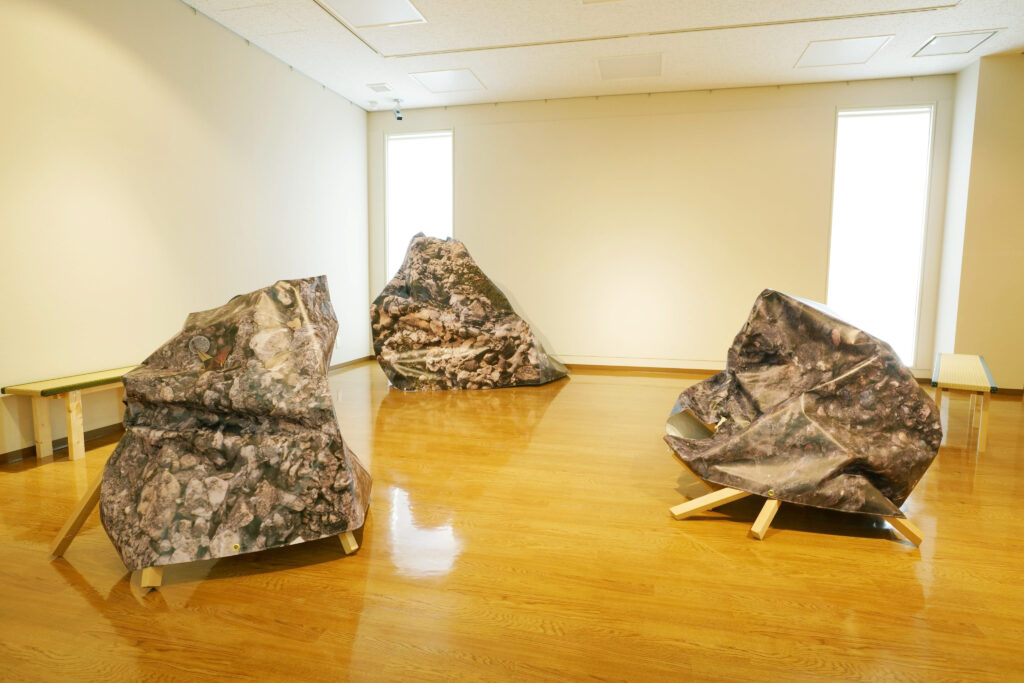
本作は、都内の神社にある「さざれ石」の写真を撮影し、それらをターポリンに印刷したうえで、垂木を組んだフレームを覆うように構成されたソフト・スカルプチュアである。

日本の国歌「君が代」において「さざれ石」は、細石が長い年月をかけて凝結し巌となるという象徴性を持ち、国家の永続性や共同体の結束を表象する記号として機能してきた。しかしその強度は、物質としての岩そのものにあるのではなく、語りと解釈の反復によって支えられているのではないか。

また「君が代」自体も、『古今和歌集』以来の長い受容の歴史のなかで、時代ごとに解釈を変容させながら読み替えられてきた。その姿は、形態を保持しながらも意味が絶えず更新され続けるテクストとしての憲法にも似ている。

国民の絆を謳うこの巌は、果たして確かな強度を持つのだろうか。それとも、それは常に更新され続ける解釈の累積によってのみ成立しているのだろうか。

This work is a soft sculpture constructed by photographing sazare-ishi (a cluster of pebbles traditionally regarded as a sacred stone) found in shrines in Tokyo, printing the images on tarpaulin, and wrapping them around a framework assembled from scrap wood.

In the Japanese national anthem Kimigayo, “sazare-ishi” carries the symbolism of small stones gradually cementing together over a long span of time to become a massive rock, functioning as a signifier of national continuity and communal unity. However, the strength of this image may not lie in the rock as a physical substance itself, but rather in its sustained repetition through acts of narration and interpretation.

Likewise, Kimigayo itself has been continuously reinterpreted and reread throughout history since its inclusion in the Kokin Wakashū, shifting its meaning across different historical contexts. In this sense, it resembles a constitutional text whose form remains intact while its meaning is continually updated.

Does this rock, which sings of the bonds of the nation, truly possess a stable strength? Or does it exist only through accumulated layers of interpretation that are constantly revised?