たとえば日中の晴れ間には星が見えないように、強い明るさで充実した空気に隠れている、ひとつのあるいはいくつかの小さな明るさが、どこかにあるとしよう。その小さな明るさは、強い明るさを受けた事物の明瞭な輪郭と対照をなし、まるで存在していないかのように私たちの眼をすり抜けている。しかし、強い光の供給が何らかの要因によってひとたび抑制されたなら、その度合いに応じて、隠れていた明るさと可視性の質を交換することになる。隠れていたものが現われ、現われていたものが隠れる。この交換の回路は、そのつど豊かに表情を変えながら反復されていく。
灰原千晶の作品について考えるとき、そのいくつかは、こうした回路に言及するもののように思われる。それらが提示するのは、何らかの完成した表象ではない。それらはむしろ不完全な、すなわち建設の過程にある、あるいは知られつつある何ものかのイメージにかかわっている。だからその様相は、なかば必然的に、持続的・運動的なものとなる。ときには身体が、そうしたイメージの媒体として、ある対象なり別の身体に関与し、関与される。
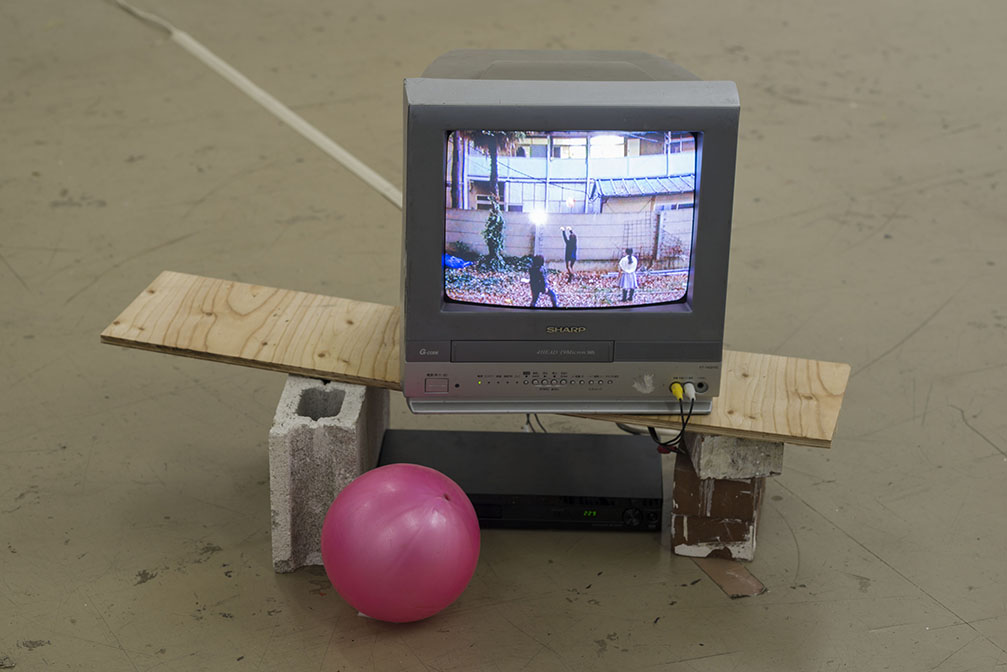
このように身体を組み入れたケースとして、たとえば《playground》(2015)[fig. 1]がある。敷地を隣接する武蔵野美術大学と朝鮮大学校との合同企画展「武蔵美×朝鮮大 突然、目の前がひらけて」(2015)に出品された作品だ。その映像には、両校を隔てる塀をネットに見立ててバレーボールをする、一連の行為が記録されている。ネットに見立てているといっても、それは視線をはね返す壁であるために、そのプレーにおいては、互いに相手側の様子を観察することは許されていない。送り出したボールがどのように受け取られるか(あるいは受け取られないか)、そして塀の向こうからどのようなボールが送られてくるか、その見届けと予測は困難だ。思いもしない形で突然現われるボールに、意表を突かれもするだろう。
そこにあるのは、けっして円滑とはいえない交渉の場であり、そのプロセスに従事する、不安を抱えた身体である。逆にいえば、見えるものと見えないもの(見なくてよいもの)がいつも決まりきったものであるならば、私たちは不安とは無縁でいることもできるだろう。だが本作が描き出していたのは、不安が無視できないものとしてあるからこそ、ボールの交換を声の交換によって補いながら(たとえば「人数増えました、こっち」という報告)、ゲームの場を成立させようと試みる過程だった。それは、共有可能な秩序を開発する努力でもある。
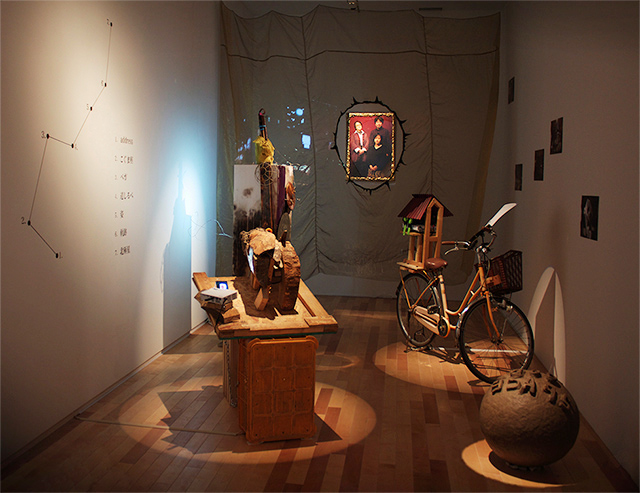
こうして形成される秩序は、ひとつの関係の図式といえる。だがもし、ある図式をいつしか既成事実(決まりきったもの)と見なすようになってしまえば、そのとき私たちは、最初にみずからが異を唱えたはずの態度を内面化してしまうことになる。《北極星を動かす方法をめぐって――いくつかのタスク》(2012)[fig. 2]において灰原が企んだのは、そうした膠着状態をほどいて押し開き、新たな図解として再結節化する手続きだった。決まりきったもの、動かないものを、どうにかして動かすこと。航海者が進路を判断する助けとしたように、北極星は天空の決まった場所にいつでも必ず投錨されていると見なされてきた。だが実際には、北極星は少しずつ動いている。そうした現象からも示唆を受けつつ、「北極星を動かす」という課題への応答として灰原は、北極星というモチーフをそれにまつわる神話や連想といった想像的ファクターによって次々と修飾していった。こうして書き起こされた脈絡を複数的に布置し、その媒体となる個々のイメージやオブジェのあいだに、呼応的なコノテーションを活動化させる。それは意味形成の磁場、様々なイメージの比較参照の図式を活動化させることである。この図式は原理的に、再結節化=縫い直しへと開かれている。それは、現われていたものが隠れ、隠れていたものが現われるような事態だ。北極星は、意味の生産という次元において「動いた」わけである。
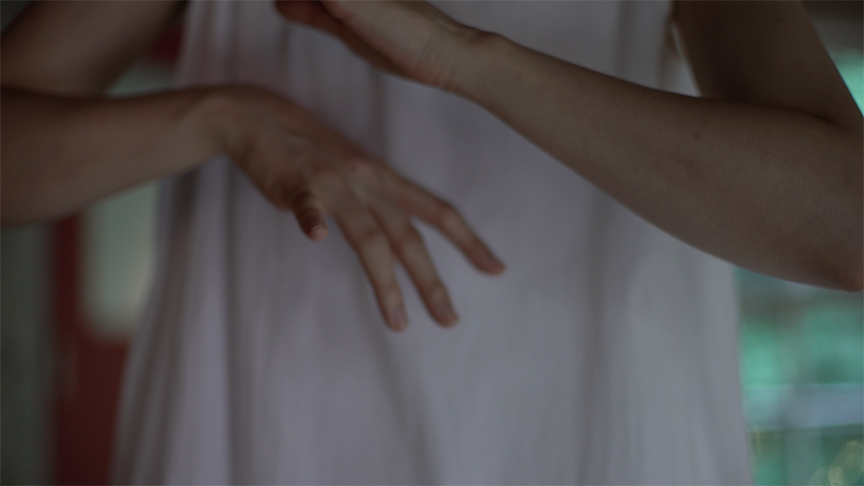
動く北極星は、航海者を迷わせるかもしれない。北極星と航海者のこの関係にはどことなく、あのバレーボールの図式を思わせるところがある。そして今回の、つまり本稿がそれに向けて書かれているところの展示において、灰原が取る構えもまた、この質感と無関係ではないはずだ。撮影者(カメラ)との距離の変化に応じて、そのつど焦点化と脱焦点化、再焦点化を繰り返すダンサーの身体の部分。それぞれに特有の属性を備え、ことによると可塑的な形態をもつ媒質に投じられ、屈折し、透過し、反映し、揺動し、あるいは放散するイメージ。演者の舞は宗教的な忘我をモチーフとしたものである。ならば、それはまた新たな形で、(我=私の身体という)輪郭の画定と解消、あるいは再定義にかかわっていると、こう期待してみることは妥当だろうか。
Just as the stars cannot be seen in the middle of a sunny day, let us assume that hidden somewhere in the air saturated with strong light, there is a weaker light or multiple sources of weaker light. In contrast to the sharp outlines of objects lit under the strong light, the weaker light escapes our vision as if it does not exist at all. But if the supply of the strong light were to be interrupted momentarily for some reason, its level of visibility will be exchanged with that of the hidden light, in correlation to the degree of interruption. What was once hidden will be revealed and what was visible will become hidden. This circuit of exchange repeats itself, intricately changing its expressions each time. When thinking about Chiaki Haibara’s work, it seems as though some of her pieces speak to these circuitries. Her work does not offer a complete form of representation. Rather, they are tied to images of something that is incomplete, that is to say, is in the process of construction or becoming known. For this reason, they almost necessarily appear durational and kinetic. At times the body becomes the medium of such an image and it engages or is engaged with a particular object or another body. Playground (2015) [fig. 1] is an example of her work that incorporates the body. This piece was shown in the exhibition Suddenly, the View Spreads out before Us (2015), a joint project between Musashino Art University and the adjacent Korea University. A video of this piece documents a series of actions in which performers play volleyball across a wall that separates the two schools. They use the wall as a net, but the wall functions to repel the gaze and the players are not permitted to observe the opponent’s side. It is difficult to visually follow how the ball will be received (or not received, as the case may be) and to predict how it will be returned. A player may well be caught off guard by a ball that suddenly appears in a completely unexpected way. What exists there is a place of negotiation that is by no means effective, and anxious bodies that must engage in such a process. To put it conversely, if what can be seen and what cannot be seen (what does not need to be seen) are predetermined and fixed, we may live free of uncertainty and anxiety. But what Playground portrays is a process in which the players attempt to establish a rally, supplementing the exchange of the ball with the exchange of voices (for example, in one instance a participant reports, “we’ve added a player on our side”) precisely because the uncertainty cannot be ignored. This is also an effort to develop a system that can be shared between the teams. A system that is formed in this way can be seen as a diagram of a relationship. But if we come to regard the diagram as a fait accompli (something that is predetermined), in that moment we internalize the very attitude that we were initially opposed to. In other words, even when such a diagram is established, uncertainties remain (the diagram is affected by complex changes in the relationship), therefore to accept the diagram as being fixed, i.e., to look past the variables as that which do not need to be seen, is to face away from the unknown. This attitude seems to contradict the initial intent of the actions: to confront the unknown. In the piece Imaging How to Move the Polaris—Several Tasks—, Haibara devised a procedure to break and push open a state of deadlock so it can be restructured as a new diagram. It is an act of somehow moving a thing that is predetermined and immobile. Historically, Polaris has been viewed as a star that is always anchored in the same position in the sky, and voyagers utilized it as a navigation guide to set the course of travel. But in reality, Polaris moves little by little. This is one of the phenomena Haibara draws upon in response to the task of “moving Polaris” as she successively modifies the motif of Polaris using imaginative elements such as myths and associations. Employing images and objects as the medium, the connections made legible in this process were plurally placed, and responsive connotations were activated in the spaces between the objects. In other words, she activates the magnetic field where meaning is formed, the comparative and referential diagram of various images. In principle, this diagram leads to a restructuring i.e., the act of re-sewing. This is analogous to a condition in which what lay in plain sight becomes hidden, and what was hidden comes into view. Within the dimension of meaning-production, Polaris has in fact “moved. ” A moving Polaris may lead a voyager astray. This relationship between the star and the traveler somehow brings to mind the formation of the volleyball game. The qualities of this relationship are also related to the stance that Haibara takes in the exhibition Re-sewing Constellation, for which I am writing this text. Each time the distance changes between the videographer (camera) and the dancer, parts of the body repeatedly come into focus, then out of focus, and back into focus. Each equipped with its own distinctive attributes, the images are thrown into a medium that is potentially malleable, and are refracted, transmitted, reflected, oscillated or diffused. The performer’s dance is based on a state of religious trance. Given this fact, I wonder if it is reasonable to anticipate that the work, in a new form, is engaged in the redefinition or the demarcation and dissolution of the outline that is the body of one’s self.