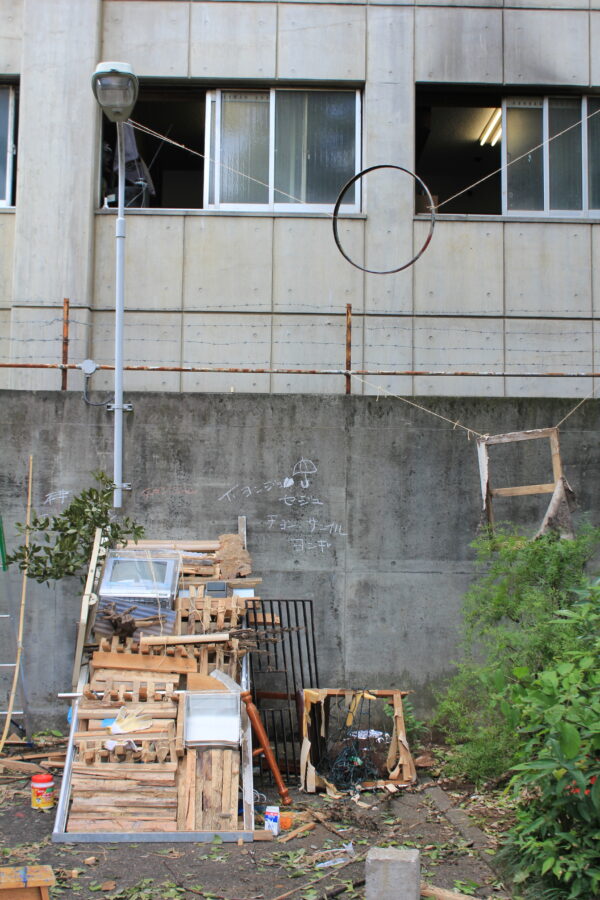
Installation view of "The Bridge Which May Be Crossed," located at the edge of Musashino Art University, adjacent to the dormitory of Korea University, 2011.
渡れるかもしれない橋
The Bridge Which May Be Crossed
STATEMENT
私が武蔵野美術大学3年生の時に配当されたアトリエは大学の端にあり、区画壁の向こう側には朝鮮大学校の学生寮があった。そこには、日本で生まれ育った在日朝鮮人の同世代の学生たちが暮らしていた。
当時私は、3.11以降、周囲の人々が同じ方向を向いているように感じ、はじめて「共同体」が立ち上がる様子を強く知覚した。そして、同じ土地に暮らす他者と直接話したいと考えるようになった。彼らの存在には以前から気づいていたものの、このとき改めて認識したのである。
大学1〜2年生の頃、武蔵美に入るときと同じように正門から朝鮮大学校を訪れようとしたが、受付で止められ、中に入ることはできなかった。(後に全寮制によるセキュリティのためだと知った。)当時の私にとって、彼らは「よくわからない存在」だった。
話したいと思いながらも、どのように声をかければよいのかわからなかった私は、彼らの目に留まるよう、寮の目の前で未完成の構造物を作り続けることで、「話しかけられること」を待つという方法をとった。
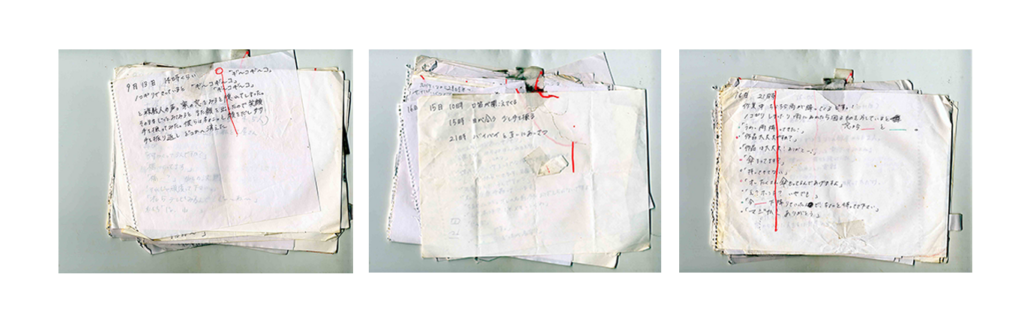
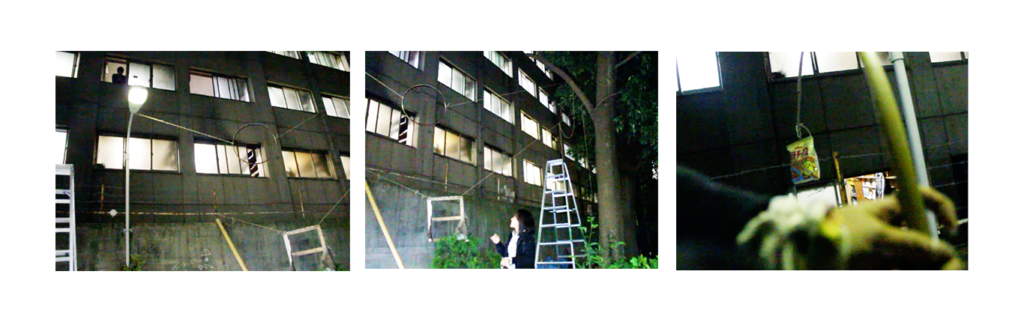
やがて彼らが「何をしているの?」と声をかけてくれたことをきっかけに、この出来事は一つの作品へと展開した。本作は、雨の日に貸してもらった傘へのお礼を渡す場面を収めた映像と、日々の記録日誌によって構成されている。
他者との距離や接触の困難さを前提としながら、その関係がどのように立ち上がりうるのかを試みた作品である。
When I was a third-year student at Musashino Art University, I was assigned a studio at the edge of the campus. Beyond a partition wall stood a dormitory of Korea University, where students of the same generation as me—Zainichi Koreans born and raised in Japan—were living.
At that time, especially after 3.11, I felt that people around me were all facing in the same direction, and for the first time I became acutely aware of how a “community” takes shape. I began to feel a strong desire to speak directly with others who live on the same land. Although I had noticed their presence before, it was at this moment that I truly recognized it.
During my first or second year, I tried to visit Korea University through its main gate, just as I would enter my own university, but I was stopped at the reception and was not allowed to enter. (I later learned this was due to security measures related to the dormitory system.) At the time, they were, for me, people I did not really understand.
Although I wanted to speak with them, I did not know how to approach them. Instead, I chose to wait to be addressed: I continuously built unfinished structures in front of their dormitory, in the hope that it would catch their attention.
Eventually, when they approached me and asked, “What are you doing?”, this encounter developed into a work. The piece consists of a video documenting a moment in which I return an umbrella they lent me on a rainy day, along with a daily record journal.
This work attempts to explore how a relationship can emerge despite the distance from, and difficulty of contact with, others.