音の所在と主体の境界の揺らぎ。
若い頃、周囲の大人には聞こえない高周波(モスキート音)が聞こえることがあった。それは確かに外部に音源が存在し、意図的に設置された音であった。しかしいつの間にか、そのような音は音源の有無とは関係なく、内側で反復されるようになる。今日では、特定の周波数帯の音や声に触れたとき、耳の奥でざわめくような感触が重なって知覚され、それを分離して処理する状態が生じている。
一般に音は、外部の振動が身体を通して電気信号へと変換され、脳に伝達されることで知覚される。一方で耳鳴りは、外部に音源が存在しない、あるいは極めて微細である場合でも、脳がそれを補完し増幅することで生じるとされる。しかしその音が外部に由来するのか、内部で生成されているのかを、日常の中で確かめる術はない。そこに「ある」のか「ない」のかは、最終的に“わたし”の判断に委ねられている。
耳鳴りは、外部に音源を想定することも、内的な現象として理解することも可能な事象である。その曖昧さのなかで、わたしはそれを侵入者として捉える。同時に、“わたし”自身もまた、それに他ならない。
ジャン=リュック・ナンシーは、自身の心臓移植の経験をもとに、「侵入者(L’intrus)」について、自己の内部における異物性として論じている。侵入は単一の出来事ではなく、むしろ増殖し、内部で差異化し続ける過程である。自己とは、そのような異物との関係の中で絶えず変容する存在である。
この身体は、外部との接触を通して自己をかたちづくる。同時に、外部にあったはずのものを内部に取り込み、変質させながら記憶として蓄積する。それらは反復され、時に過剰に増幅され、他の知覚を覆い隠すほどの強度を持つこともある。
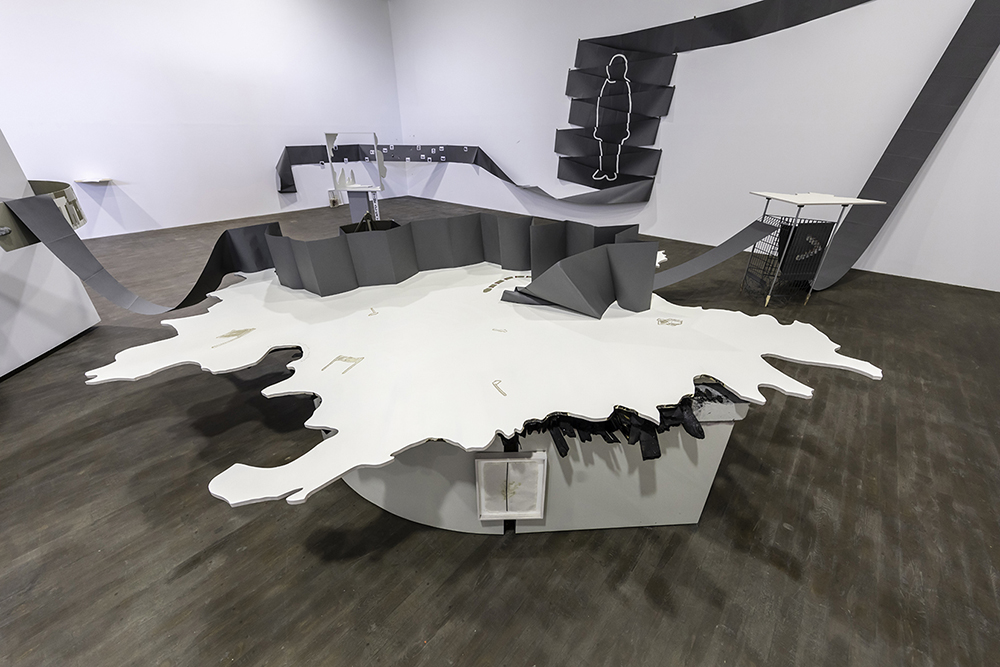
本作は、音が内にあるのか外にあるのか、その判別が揺らぐ地点において、主体の境界がどのように生成されるのかを問うものである。
ものごとを即座に判断し結論づけることが求められる状況のなかで、いずれにも回収されない状態を保持すること。それは、侵入者を抱えながらなお“わたし”であるために確保されるべき領域である。
耳鳴りは続く。それは警報のように身体の奥で反響し、ときに他の音をかき消す。日常のなかでそれをやり過ごしながら、わたしはその所在を問い続ける。
Where sound resides, the self wavers.
When I was young, I could hear high-frequency sounds (often referred to as “mosquito tones”) that the adults around me could not perceive. These sounds certainly had external sources and were intentionally installed. Yet over time, such sounds began to repeat internally, regardless of whether an external source was present.
Today, when I encounter sounds or voices within certain frequency ranges, a faint buzzing sensation seems to overlap from deep within my ears. I find myself in a state where I must separate and process these layers of perception.
Generally, sound is understood as external vibrations that pass through the body, are converted into electrical signals, and transmitted to the brain where they are perceived. Tinnitus, on the other hand, is said to arise when the brain supplements and amplifies signals, even in the absence of an external source, or when such a source is extremely faint. Yet in everyday life, there is no reliable way to determine whether a sound originates externally or is generated internally. Whether it is “there” or “not there” is ultimately left to the judgment of “myself.”
Tinnitus is a phenomenon that can be understood either as presupposing an external source or as an entirely internal occurrence. Within this ambiguity, I perceive it as an intruder. At the same time, I myself am nothing other than that.
Drawing on his experience of a heart transplant, Jean-Luc Nancy theorizes the notion of the intruder (L’Intrus) as a form of foreignness within the self. Intrusion is not a singular event; rather, it proliferates and continuously differentiates within. The self is something that is constantly transformed through its relation to such foreign elements.
This body takes shape through contact with the outside. At the same time, it internalizes what was once external, transforming it and accumulating it as memory. These are repeated, at times excessively amplified, and may attain an intensity that overwhelms other perceptions.
This work asks how the boundary of the subject is constituted at the point where the distinction between internal and external sound begins to waver.
In a world that demands immediate judgment and resolution, to sustain a state that cannot be fully subsumed into either side becomes essential. It is a space that must be secured in order to remain “myself” while harboring the intruder.
The tinnitus continues. It reverberates deep within the body like an alarm, at times drowning out other sounds. As I move through daily life, letting it pass, I continue to question its location.