「灰原による室井悠輔の作品記述」についての記述
室井悠輔 / Yusuke Muroi
灰原によって作品で記述された事実について私はここに記述したいがどうにも言葉が浮かばない。これらの作品は私に思考停止を強いてくる。そもそも「相手の作品を自分の作品で記述する」という展覧会のタイトルとそのテーマによって作られた作品がどのように立ち現れるかは鑑賞者によって大きく異なり、少なくとも当事者(私たち)と来場者(それぞれ異なる距離にある他者)での解釈は異なる。その上で彼女の作品が私に招いた印象は思考停止であった。それは私の作品が彼女によってこの空間に記述(展示)された内容に同意できたかどうか分からない、ということかもしれない。とにかく思考停止では何もここには書けないので、今回展示された彼女の作品が私の作品を記述したものではなかったと仮定して、彼女の作品に対する私の気づきをそれぞれの作品に対して記述しようと思う。その上で思考停止の正体を炙り出し、作品によって記述された正体について考えたい。
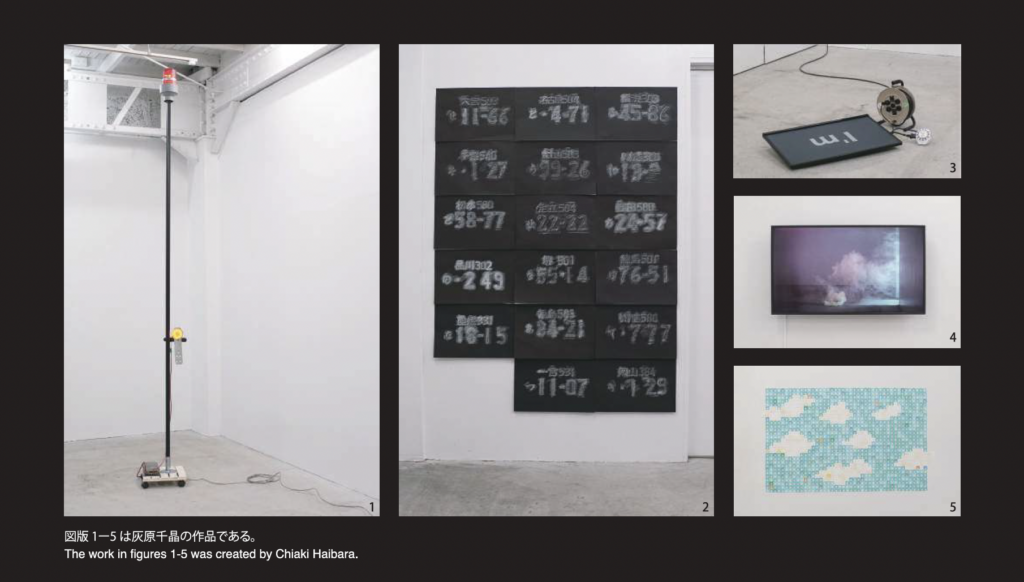
まず《消防車》[図版1]という作品について、これは消防車の概念を一部抽出し、ミニマルに仕立てたものと思われる。赤い警報ランプと反射板は消防車の実際の高さに合わせたというが、それを繋ぐ黒いステンレス製の棒がどうにも気になる。この空間の場合黒子として機能するわけでもなく、棒自体が何か主張をしているように感じられる。警報ランプと反射板は消防車の概念の一部とみなされるだろうが、この棒はその概念に値しない。私はその棒に興味を持つ。次に《ナンバープレート》[図版2]という作品について、これはグラフィティとアートの間の子として捉えられる。手法としてはフロッタージュという過去の芸術における技法だが、対象が路上のナンバープレートであることが興味深い。それによって、所有者から見つからないようにするための作者の緊張感が線に現れる。つまり路上でのグラフィティとアートの間にある余白がある。では続いて《忙しいテレビ》[図版3]という作品についても同等のことが言える。これはタイトルと相まって休憩をするテレビということらしい。床置きのテレビを寝ているとみなすことに無理があるように思われ、また15分ものあいだ電源が切れる仕様もあり、分かりにくい。しかし、休憩という労働の裏側に焦点を当てている点で興味深い。加えて今回展示された《カラーフィールド》[図版4]という作品についても同等のことが言える。これは夜間にギャラリーで色付きの煙玉を発火させ、ギャラリー内が煙に包まれていく様子を撮影した映像作品であるが、《忙しいテレビ》のように、夜間のギャラリーという、営業時間外という主たる時間に対する外側を見せている点が気になる。それでは最後に《ビューティフル・スカイ》[図版5]という作品について考えてみたい。まず私はここに展示された作品以上に彼女の収集の徹底ぶりに驚いた。この作品に使われている素材(パンを密閉するためのプラスチック製の留め具)は彼女とその家族が朝食をとった記録の集積として捉えられる。そしてここに展示されたそれはほんの一部に過ぎないのである。生活とともに発生するものをここまで収集したことは私にはいまだかつてない。純粋かつ生々しい存在として羨ましくもある。
以上が今回展示された彼女の作品が私の作品を記述したものでなかったと仮定した場合の意見である。そして、ここに私の作品の本質があるのかもしれない。上記の意見は私が制作するときにも通じるものの見方である。それを彼女が意図していた、意図していないにに関わらず、引き出すことができたということであるならば、私の作品を記述したと言ってもよいのではなかろうか。ここでどうやく頷くことができ、思考停止を招いた理由は私の美学とは異なる美学で展示をしていたからということかもしれない。今回の展覧会で灰原が多用した黒色は私がこれまでに使用してこなかった色である。また、音を使用しないミニマルな手法の映像など、私がこれまでに扱わない方法でアウトプットをおこなっていた。その理由は灰原のアイデンティティに他ならないはずだが、自己の文脈から離れることを少なからず強いられながら互いに制作することは自己犠牲を招く。それをポジティブに捉えることができるかどうかは最局のところ今回のような必然性ありきでこうした展覧会がおこなわれたかどうかによるのだろう。しかし、そもそも今回の展覧会が選抜展としての二人展である以上、その必然性は根本的に揺らいでしまう。にも関わらず今回の展覧会を試みたのは必然性を探ろうとしたかったからであり、結果を前提としないプロセスが重視されるべきだ。ゆえにこの展覧会は未完成であり、お互いが美術家になるための通過点として必然性を帯びた展覧会であることを望んでいる。それは逆説的に必然性ありきの展覧会ということにもなりうる。
「室井による灰原千晶の作品記述」についての記述
灰原千晶 / Chiaki Haibara
地球という惑星の、日本と呼ばれている場所にうまれ育ち、日本の国籍をもっている一日本人?/生物学的に女性と定義される器をもっていて一女? /定義された時間ゾーンでは、それが定義されてから地球が太陽を約2019周回ったあたりを生きている一現代人?/与えられた名前をもつ一灰原千晶?
社会的に必要なので付与されるものを除いていくと、私を私たらしめるものはほとんどないように思われ、そういう自我意識の希薄さから、「私はここに存在します!!!!」という強烈な物体と出会うと、なにやら自分の魂しきものとの間に豊かな摩擦が発生し、とてもどきどきする。それが私の実在を証明し、思考を活性化させるからだ。だから今回は、私の作る作品やその制作姿勢を室井がどのように読み取り、そして彼が作品としてどのように記述するのかという意味で、ギャラリーでどんなものと互いにどんなだろうと思っていた。
彼の作品を前に最初に感じたのは、彼は記述しているのか?という印象だった。記述とは、対象とする事物の特質がわかるように記すことではなかったか。記述された特質が記述者の視点に立っていることは大前提で、作者の制作を通した振る舞いや、作品の他者性を、作者本人の前に現前させること。そうするためには、それなりに相手の思考回路について考えないといけないと思し、現前したものに対して、被記述者は互いにどのような考えに至るか、自分が(まだ)知らない/他者的な自分に出会うことはどういうことなのか。私はそのような理解のもと取り組んだつもりだったが、私がそこで出会った作品は、どこまでも室井悠輔だったように思う。その上で彼の作品をみてみたい。
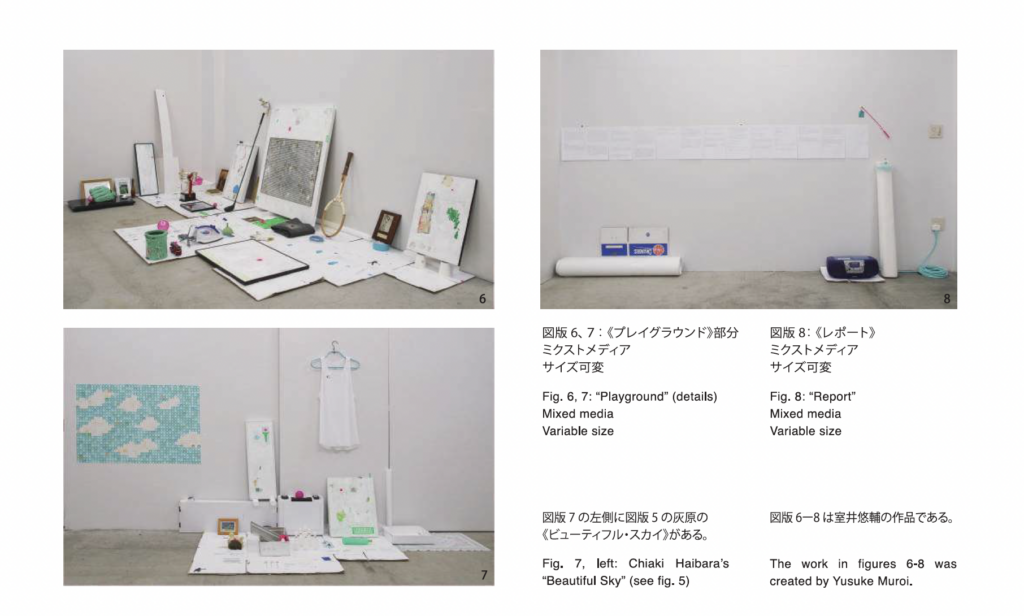
まず、彼が事前に送ってくれた彼自身の作品や思考の推移を解説した文章に応答する形で私が送った同様の文章の中で、私は過去の自作《Playground》は遊び場でない場所が遊び場になる様子と、そこでルールが発生する状況を映像作品化したものであると説明した。その作品の中で扱われている100円ショップで購入したピンク色のビニールボールはありふれたもので、彼の過去の作品にも登場していた。彼はそこに共通項を見出し、今作《プレイグラウンド》を作った。そこではピンク色のボールを象徴するようなピンク色の丸いもの(シールやスーパーボール等)が空間の絵画的な統制を保つなかで、ミクロ的に派生する雑多な情報(既存のゲームであるテニス、ゴルフ、野球やゲームに連想される、運動着、トロフィーなど)にリンクされ、彼のプレイグラウンドはそのような彼のルールのもとで拡張していく。《レポート》では、前述した私が送った文章が、外部システム(google翻訳)を介した操作により、部分的に書き換わっている文章(例えば美術大学を卒業が美容学校を卒業だったり。)が貼り出されている。そこに原文は存在せず、一度google翻訳で英語に翻訳されたものと、それを再度日本語に翻訳された二言語が貼り出されている。
このように、《プレイグラウンド》でも、《レポート》でも、作品中で行われていたのは、そこにある物語を、まさにいろいろな情報をミックスすることで撹乱することであったように思う。扱われている物語が私のものであったから、私の視点で撹乱といったが、彼の言葉でいえば撹拌だろう。それはどこまでも室井の姿勢だった。その物語が彼自身のものであったとしても、彼が岡本太郎美術館で展示していた作品《平凡な芸術家(仮)は本物の芸術家たり得るか。(すべてを最初から始めたい)》で見られるように同様だろう。しかし、彼は今までの作品において、撹拌過程におけるすべての選択・操作を自分自身の手で行ってきた。今回私の差し出した(あえていえば私は物語という原材料を提供させられた)物語を加工する際に一見お手軽すぎるように見えるgoogle翻訳を使ったのは、なぜだろう。彼は「私が突然これまで行ってきた制作活動をリセットしてしまう設定として使った」と言う。しかしgoogle翻訳はたまに驚くような語彙の変換をみせてくれるが、原文を全く別のものにはしない。彼にとって今回このような手法をとることは、元の物語が何であるか痕跡を残すのに役立ち、自分の意図とは離れたところで結果が生まれてくれることから、特定の誰かの物語へ踏み込むことへの拒否という一つの態度であったのかなと思う。ここでいう拒否とは、やってられるかよという拒否というよりも、他者個人の物語へ踏み込むことへの躊躇、あるいは優しさである。
Description of Haibara's Description of Yusuke Muroi's Work.
— Yusuke Muroi
While I'd like to use this space to describe what was described by Haibara in her artwork, I seem to be at a loss for words. These pieces have compelled me to draw a blank. For starters, the manner in which the title "Artwork to Describe Each Other's Work" manifests itself will differ widely depending on the viewer. The same goes for the work created according to this theme — or at the very least, the interpretations of the interested parties (us) and that of the audience (others with whom we have varying degrees of closeness) will differ. And the reaction her works incited in me was to go blank. Likely the issue was that I wasn't sure if I agreed with the idea that my work had actually been described (exhibited) by her. In any case, drawing blanks is not going to help me actually write anything here, so, going on the assumption that her work was not a description of my work, I will go ahead and describe, piece by piece, what I noticed in what she exhibited. In this way I'd like to reveal the truth of this "blank" — to consider the truth of what was described by these artworks.
The work "Fire Truck," [fig.1] for starters, seems to be a minimally constructed abstraction of the concept of "the firetruck." A red beacon and a reflector are arranged at the actual heights they would be at on a real truck. The black stainless steel pole connecting them, however, is impossible to ignore. Given the context of the exhibition space, one doesn't feel as though it were acting as a behind-the-scenes structural support, but rather that the pole itself must be making some kind of statement. I don't think it's difficult to regard the beacon and the reflector as portions of "the firetruck," but the black pole is auxiliary to this concept. As for me, I'm interested in the pole. Next we have "License Plates," [fig.2] which could be understood as a hybrid of fine art and graffiti. What I found very interesting was that while "frottage" was used in the work's creation, this classical technique was applied to license plates found on the street. The artist's nerves, worried she might be caught by the cars' owners, accordingly appear in the lines of the drawings. Which is to say, one could also consider it as a new possibility for graffiti, the "real-time" feeling of which typically cannot be taken from the streets and reconstructed in a gallery. Now I'd like to turn to the work "Busy TV." [fig.3] As we can infer from the video's intertitles, this apparently consisted of a television taking a break. I found it difficult to understand — it's not easy to look at a television placed on the floor and imagine it as if it were asleep. The specification that it turn on and off every 15 minutes didn't help, either. However, I found it very interesting that the focus was placed on "rest" as the obverse of "labor." One could say the same about Haibara's other work, "Color Field," [fig.4] which was also exhibited in the show. Here we have a video portraying colored smoke bombs set off inside the gallery at nighttime. Like "Busy TV," this fascinates me in that it shows the gallery at night — the counterpart to its dominant time (its operating hours.) And finally I'd like to consider "Beautiful Sky." [fig.5] I was less surprised here by the work itself than by the painstakingness of the collection Haibara presented. We might interpret the materials in this piece (the plastic fasteners used to seal bread) as an accumulation of testimonies to the fact that she and her family had eaten breakfast. As it turns out, what she exhibited was only one small portion of what she had collected. I had never seen such an impressive compilation of the items that amass in one's daily life; I was also envious of the raw, unaffected qualities betrayed by her behavior.
The above opinions are based on the assumption that the artwork exhibited by Haibara did not describe my work. And here we perhaps find my work's essence — we could apply these opinions to my own creative production. Whether or not it was intentional, if she was in fact able to draw this out, one might be able to say that she effectively did describe my work. I will yield on this point. I suppose I was initially provoked to draw a blank precisely because I had seen my own aesthetic exhibited using a different set of aesthetic principles.
I have never used the color black, which Haibara employed heavily in this exhibition. I have also never worked with many of the methods (such as minimalist, silent video) with which she created her final products. I'd guess the only possible reason for this disparity would be that Haibara has her own particular identity. And yet, there was a form of self-sacrifice provoked by the reciprocal creation process to which we had subscribed — we had constrained ourselves to take a step away from our own personal contexts. I'm tempted to say that being able to take such circumstances positively ultimately depends on whether or not we felt the exhibition was founded on a sense of meaningful necessity. Such a necessity was already fundamentally destabilized for us from the start, however, due to the fact that we were selected for this exhibition by an outside authority. And yet, given that we nevertheless set out on this attempt with the aim of finding the necessity for ourselves, it is the process that should be treated as important here, rather than its results. This exhibition is, accordingly, unfinished. We hope that it will take on a sense of necessity for both of us, as an important waypoint on our journey to becoming artists — one might say, then, that the exhibition could paradoxically have been founded on necessity from the start.
------------------------------------
Description of Muroi's Description of Chiaki Haibara's Work
— Chiaki Haibara
Born and raised on the planet earth in this place called Japan, with Japanese citizenship — an individual Japanese person? Possessing the parts biologically defining one as female — an individual woman? Living in a time zone that, since its delineation, has revolved around the sun roughly 2019 times — an individual modern human? Bearing a given name — an individual Chiaki Haibara?
It seems once I've cast away all that's been bequeathed by social convention, there isn't much left to make me me. This frailty of ego-consciousness gives rise to an irresistible physicality screaming "I'm here, I exist!!!!" — encountering it, a rich discord emerges between myself and something almost like my soul, and my pulse quickens. My actuality has been testified to; my thoughts have been stimulated. So I was curious about what I'd be confronted with in the gallery — about how Muroi had understood my work and my attitude toward creation, and how he'd describe all of this using an artwork.
My first impression was to be unsure if his work was really a "description" of anything. "Description," I had thought, would be the act of making an account of something such that its particularities could be understood. Given that this would necessarily take place from the point of view of the one doing the describing, it would be vital that the otherness of the artwork or the postures implied by the artist's creation processes be drawn out and presented to the artist themself. To do this, I figured we would have to take each other's respective ways of thinking into consideration. What sorts of ideas might the described parties arrive at together, concerning that which has been brought before them? What might it mean to meet a (yet) unknown "me"/myself as an "other"? This was the basis on which I had been intending to approach the exhibition. What I ended up encountering there, however, seemed to be Yusuke Muroi through and through. This is the regard in which I would like to take a look at the artwork he produced.
I had given Muroi an explanation of "Playground," a past piece of mine that involved filming a certain location's transformation into a playground, as well as the concurrent emergence of a set of rules and regulations. I sent this to Muroi in response to a text he had sent me prior, describing his own work and the shifts that had occurred in his way of thinking. In "Playground," I used a commonly found pink plastic ball purchased at the 100 yen store; the same ball had appeared in a past work of Muroi's. He zeroed in on this similarity and created the work "Playground." [fig. 6, 7] Developing itself on the basis of his own rules and regulations, Muroi's playground was held together by an assortment of information inferred through details (objects — sportswear, trophies, etc — calling to mind games such as tennis, golf, or baseball) and visually structured by a series of pink circular items (stickers, bouncy balls) representing that pink plastic ball. In "Report," [fig. 8] the aforementioned text I had sent was put on display, rewritten piece by piece via the mediation of an outside system (Google Translate — for example, "graduated from art school" became "graduated from beauty school.") The original work was not exhibited: only the text translated once, with Google Translate, into English, then another that had been translated back from the English into Japanese.
In both of his artworks, then, I felt there had been a disruption of the preexisting narratives on which they were based, engineered precisely through the introduction and intermixing of a variety of pieces of information. I'm calling this a "disruption" because the narratives used happened to be my own, but I suspect Muroi might use the word "disturbance." That is what he has always been about. One might say he treats even his own narratives in the same fashion — as can be seen in the work he exhibited at the Taro Okamoto Memorial Museum, "Can (Ordinary Artist) Become Real Artist? (I Want to Start Everything from Scratch.)" Up until now, however, Muroi has made every choice and enacted every manipulation directly, using his own hands. Why is it, then, that he used Google Translate when working with the narrative that I presented to him (or, dare I say, that I was coerced into offering him as a raw material for his work)? At first glance it almost seems too easy. He claims he "used it to 'reset' the work [he] had been doing." But while Google Translate can sometimes alter specific words in surprising ways, it doesn't entirely do away with the original text. I'm inclined to believe that the use of such techniques — which allow results to manifest without intentional action on his part — represented one means of refusing to take a step into the narrative belonging to a specific human being, without erasing all traces of what this original narrative had consisted of. I wouldn't characterize this "refusal," however, as just having been some kind of "fuck you." Rather, it could be seen as the hesitation to trespass on another's personal narrative — that is to say, a form of kindness.